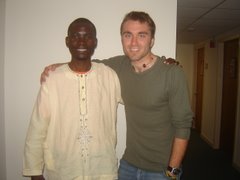
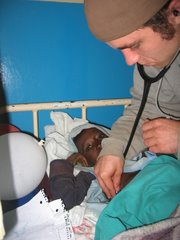
I typed a long entry about what I've been up to, but it's on my laptop and I'm not sure how to transfer it to a computer with internet capabilities. The writing is a lot of catching up that I didn't think was too interesting, so in the mean time I decided to write and share with you the small parts of my yesterday and today - everyday life in Tanzania.
Yesterday I took breakfast at my friend's house. Well, it wasn't really his house - there isn't anything to take in his house, so we went to his aunt's house. And there wasn't really anything there either. A big house with couches, a tv and pictures with broken frames in the sitting room. But then I walked through to find the bathroom - and the rest of the house was totally and strangely bare. No furniture - people must sleep on the floors. No finished floors, people must sleep on the cement. Nothing on the walls but dirt, nothing in the kitchen but a sink that dangled loosely from the wall. But his aunt brought me a big breakfast - tea with sugar and nine pieces of bread, on which she spread something that's like butter but without flavor. She was so happy to feed me that I could not be anything but happy to be there being fed.
That afternoon I was at another friend's house. Her family prepared a meal for me: ugali (hot flour pudding - equal parts flour and water, boil off the water), peas, fish, spinach, and cooked chicken heads. One eats everything but the bones, which includes the tongue, the eyes and the brain. I cannot say I enjoyed the flavors or textures, but it made me appreciate, or more wholly understand, life. What a luxury it is to choose food. And what a luxury it is to have fat. Some people here eat everything they can and don't have that opportunity.
Tonight I was in the slum again. It was the first time I felt comfortable in my Swahili - the first time I spoke without hesitation - telling stories and answering questions with more ease than I had previously known. A little boy wanted to be carried so I picked him up and told him not to pee on me - and then on that moment realized I had just told him not to pee on me in Swahili. I like that place. When I am in the center of the slum I am protected because I am known and loved.
It rained most of the day, and consequently uswahilini (the swahili place - the slum) was filled with mud. The kids walked me back to the bus station just before dark and I hopped on the next available daladala (what the rest of Africa has called a matatu). There are seats for 16 people inside. We numbered 26 in all. Imagine seeing us cruise down the main road, sliding door open. Inside people are sitting in their seats, squashed by the other people standing between their legs, leaning against their faces, squeezed into every pocket of space from floor to ceiling. Then three of us, myself included, are situated outside the van, standing on a running board beneath where the sliding door would have been had it not had to have been opened to reveal some room for the inside to bulge. My hands found something on the inside to hold on to - a handle, a wrist - something reliable. And we continued like that for a few kilometers, rain spitting in our faces. That is my Africa, these are my friends, and this is my life, and I like it.
Tuesday, April 17, 2007


Wednesday, April 11, 2007
No More Mail
Hey Friends, Family-
Just wanted to say that because I will have an internship in the bush next month I will not be able to receive any mail. Also, following the internship I am flying back to the States - so if you want to send me mail, rather than direct it to Tanzania, please use my Iowa address:
Ben Huntley
1501 Westview Drive
Coralville, Iowa 52241
USA
My apologies for the time gap since the last post. Much has happened in Tanzania and I hope to soon compose these stories for you to read. Until then, take care.
Sincerely,
BH
Tuesday, March 20, 2007
An article
Below is a short article from the US written to college-aged kids about the music project:
You might not have read about it in the American Journal of Medicine, but they’re working on a new HIV/AIDS prevention in
The guy mixing this vaccine isn’t a chemist, he’s a producer. That is about as far as my cute little analogy can go, but this is something we all should be paying attention to. Right now, halfway across the world from where I am writing, the Kigali Boyz and Miss JoJo are recording a song with a purpose.
These days The Kigali Boyz (KGB as they’re called) and Miss JoJo are two of the biggest Rwandese music acts around. Spend any amount of time with youth in
Knowing that, Miss JoJo and KGB, along with the help of few other friends, decided that they’d put something new in Rwanda’s head, a little message about what is happening in their country and the serious public health effects this HIV/AIDS epidemic brings. A message that we all hope will cause people to look at how they are living in a world that is being devastated by AIDS, which also begs the question, “so what choices are you going to make in this new world?” This isn’t a plea for money from the West, or a guilt trip for a rich white business man (although I know
Fortunately, getting people to listen to this message should not be difficult for this group of artists. Miss JoJo’s voice is, at the same time, beautiful and accessible, while KGB’s flows carry rhythms that at times even seem to double the background beat. If you never took that music class you planned on taking at your local community college, basically what I’m saying is they’re talented and their music is catchy.
When I say that these artists are stars on
That’s what makes this song that KGB and Miss JoJo are putting together all the more impressive. These artists are not removed from the daily hardships of HIV/AIDS because of their fame. If Paris Hilton were to sing about growing up in the projects and about her violent lifestyle we’d all laugh, but when Jay-Z does it we turn it up. That’s exactly what these artists are doing. They’re not coming down from their mansions on the hill for a little public service project; they are a part of the community that is struggling to survive in the face of HIV/AIDS. They are authentic and they are good. What else is there to say?
Saturday, March 17, 2007
A Music and Public Health Cocktail: Using Hoi Polloi Heroes to Intervene in Rwanda’s HIV/AIDS Challenge
Saturday 17 March, 2007 (Happy St. Patrick's Day and belated Ides of March) - 11:41 - Dar es Salaam
I would like to share with you information on a project I created and in which I have likewise been investing quite a bit of time. Simply put, the idea is to use Rwanda’s relatively new music industry to change public psyche regarding sexual behaviour and the transmission of HIV/AIDS. But before getting to logistics, allow me to briefly explain the evolution of this project.
The idea first started forming while returning from a weekend in Congo, coming through Gisenyi, RW. Two teenagers greeted me as I was walking along the Lake Kivu shore – turned about face, and walked with me back into town. It was not long into our conversation before the boys, in efforts to impress me, compared themselves to “KGB”, claiming they could rap like their heroes – even that they could rap not just like KGB, but like P Diddy, Snoop-dogg, and the others from the US. Miraculously maintaining my cool-guy status, I simultaneously informed them that being able to rap like KGB (Kigali Boyz) did not mean anything to me, because I had not ever heard of the group. My new friends proceeded to take me to a local internet café, threw in a USB memory stick and shared their favourite songs. This is amazing, I thought – these young minds are seriously influenced by the lyrics and lines of their hip-hop heroes… more so, it appeared, than of their teachers, elders or government officials.
Back in Kigali around the same time I heard a catchy radio-cut of a song in matatus heading to and from Nyamirambo (the non-mzungu Rwandese/African bumping street-neighbourhood) – and soon discovered the beautiful, rhythmic voice belonged to a lady stage-named Miss JoJo. A co-worker at the hospital heard me singing his friend’s lyrics and gave me JoJo’s mobile number. Soon thereafter, while on a short assignment from the Kigali Health Institute to Butare, Miss JoJo and I sat down for dinner and discussed some ideas that had been perculating in my mind.
All this time I had been pouring through national AIDS data in preparation for a research proposal a friend of mine and I were submitting – and the things we found were astonishing. Instinctively we wanted to design research protocols, implement programs, and change public health through scientific means – but it occurred to me that hundreds before have already tried doing this – some successfully, many others not so. While we continue to plug away on the research, we also looked for quicker intervention strategies.
My mind jumped back to the young Gisenyi boys and I realized that the common people create heroes from within their own ranks because they think they cannot relate to the power and politics of their national leaders. So all we had to do was link their heroes with the AIDS message, back the project with government support, and – voila – the minds and matters of millions of “mnyarwandans” (as they are called in Swahili) can be reached, influenced, and changed to bring about healthier living, longer life, and a more productive society.
The night before leaving Rwanda, Gilbert and I sat down for sodas with Miss JoJo and KGB, the top Rwandese female pop-musician and hip-hop group, respectively, in the country. If one or the other released a challenging song, it would be easy for someone to isolate and disregard their statement. But if these former competitors collaborated their talents and released a song together, they’d easily have the ears and minds of Rwandese, causing formerly unpersuaded people to consider what the NGOs and the government have been saying all along to the importance of ‘ABC’ (Abstain, Be faithful, and Condomize, with priorities in that order). Realizing the power they have to influence the masses, the musicians agreed to intervene.
It costs money to do all of this, though – money for studio time, and to pay a sound-engineer to harmonize the inputs, amongst other needs. Normally musicians front the money and make it back once the song is released. However according to KGB there is a law prohibiting them from making money on songs that address HIV/AIDS, so they would not be able to make the money back. Because they are professional musicians and live off their music, they cannot afford to drop 1000 USD in the studio even if it is for a good cause, so we worked a deal. I committed $500 and promised to promote the song in the US if they fronted the rest and went through with the project. They are excited, as this is potentially their big break to be known in the US, and I am excited as this is potentially an powerful intervention in the public psyche within Rwanda. They agreed to work together, run the lyrics by Gilbert to make sure it is the message we want released, and will start rehearsing soon so as not to waste expensive studio time. Within two months they’ll be ready to record. A slight problem, though, is that I took advantage of my appearance. To them, I am a white American male, probably rich, probably connected, and therefore the path to their professional dream. Taking advantage of that misconception and calculating anticipated support from people I thought might be interested in helping Stateside, I bluffed - promising the cash as if it weren't a big deal - got them started, and now have some fundraising to do before they lay down the studio-cut. If you are interested in contributing, I’ll leave information on how to make a donation at the end of the post.
Next, we wanted to get T-shirts, posters and decals with the song title, message and musicians’ names printed in the US to distribute in Rwanda. Because matatu drivers love to put stickers on their vans, making decals of their favourite musicians that simultaneously promote the song’s message is free advertising and a probable way to subliminally affect people’s psyche. Likewise, with the T-shirts – many Africans idolize western culture, particularly that from the US, and cherish clothing imported from the States. So every time they wear these shirts in town they will also promoting sexual behaviour change. We have been in communication with a graphic design artist and a t-shirt printing business in the US who seem to be interested in donating their time and resources at a discount for the project, with specifications/recommendations for the design and color scheme coming from the musicians who know what their fans will find catchy.
That wraps up what has been established so far. Now I’ll explain where this project is heading.
We are hoping to arrange a meeting between Gilbert, Miss JoJo, KGB and national leaders, particularly the head of an AIDS-awareness organization called PACFA Rwanda. We would like to get the project integrated with national support so it can be in large part owned by Rwandans themselves and not solely implemented and sustained from outside sources. If the people see national leaders working side-by-side with their heroes, they will be much more likely to seriously consider the message we are all trying to persuade them to take into account. The musicians also want to invite a world-popular American rapper named Sean Combs (stage named P Diddy) to put his voice on the project – which would add incredible support in the minds of the common people. KGB is hopeful that President Kagame will not only work with them to issue an invitation to Mr. Combs, but will also help get merchandise printed in the US shipped tax-free to Rwanda through the Embassy.
If you are interested in donating to the project, please write a check made out to my mom (Joan Huntley) with "Rwandan Music Intervention" written in the memo (my parents’ home address is: 1501 Westview Drive; Coralville, Iowa 52241; USA). She has agreed to collect the money and will wire it to Africa when we raise the amount in full. Also, if you have ideas to help facilitate the project, please feel free to email me at: benhuntley02@hotmail.com
As always, thanks for reading, and I will catch you on the flip-side.
BJFH
Monday, March 12, 2007
*Correction*
ATTENTION:
After re-reading my previous post, I was horrified by my own analysis. What I wrote was unbalanced and unfairly harsh; I had ideas in my mind that were not accurately translated into words - and unfortunately the translation was unnecessarily negative. If in the last week you happened to log on and read the post, please re-read the edited version as it now stands. And know also that there are a lot of positives happening in Africa now.
Although they are certainly present, not every story is about corruption, mismanagement or despair. And I would point to the Rwandan government as an example of that. With tremendous respect I look at the leadership of Paul Kagame, President, and his incredible ability to balance challenges while maintaining safety, security, and stability within his country. Rwanda is a nation that has its act together and is progressing at a surprising pace - oblivious to most of the world.
Even in Tanzania, its neighboring country, people are surprised to hear that Kigali is a safe town. Tanzanians, as I suspect is the case with the people from every other country, still see Rwanda for its genocidal past and have not given it a fair analysis since. And not only do positive stories come from a governmental level, but also at an individual level there are many tales of success and hard work - many people who fight tirelessly for a bright future.
The people I most closely interacted with in Rwanda were incredible examples of this, working long hours and making great personal sacrifices so their country could move forward. The Western media already paints the continent in its worst, and it is wrong for me to add to that lop-sided depiction. Naturally I fixate and magnify weakness in hopes that doing so, taking a detailed look, will lead to a better solution. Being mindful of this, I will try to also share the strengths I see everyday but have not commented on.
Please accept my deepest apologies for posting before proof-reading, and my sincere request that you try to see Africa in a positive light.
Introspection, Thoughts from Rwanda, More Introspection, and my Mbezi Beach Classroom
Sunday 11 March, 2007 – 20:36 – Dar es Salaam, Tanzania
Leaving Kigali was not an easy move, but now with just a few days under my belt already Dar es Salaam has become a comfortable and familiar place to live. The other week my Iowa City pastor asked when my return home was scheduled – and in all honesty it took a moment to understand what she meant. Obviously she wanted to know when I’d be returning to Iowa City, but she used the word “home” – and I did not feel away from home. Cliché as it may sound, if home is where the heart is, then I am home everywhere I go – because I cannot help but dole out the depths of my soul to the people I am with.
I have been pondering a paradoxical realization of late in regards to the self. This past year put me through many experiences that profoundly impacted me. The paradox is that while on one hand I know exactly who I have become – that is, I am fully cognizant of the effect these powerful experiences have had on me - on the other I have no idea who I am because I no longer completely relate to any one culture. Certainly I am not African; I was born and raised in the United States. And yet I am not American, because I have matured in Africa. And even within this enormous blanket called Africa, I do not belong to any one people group or culture. With Samburu lips I point to objects, and with Rwandese eyebrows I acknowledge people. Even the Swahili I speak is a mixture of dialects form Kenya to Congo, and my English certainly is not the same. And more than these external markings, I have changed internally too; my whole thought process is different. I have learned to walk places with the chi in my stomach rather than with the swiftness in my legs. It is an African way of walking that I never understood until one day I saw the transformation in hindsight. And my concept of inherent rights has totally shifted. Parts of me come from so many places; I am not sure how I will culturally re-enter the United States.
Last night, for example, I went to a bar for goat and coke and struck up a conversation with a Maasai. A short while later we were head to head in one of his tribe’s rhythmic high-jumping contests – jumping and groaning, chanting, shaking our heads and rocking our chins to the same beat. Stuff like that does not strike me as odd anymore – just fun (by the way, they walk around the city just like they do in the bush, wearing traditional clothing with big holes in their ear lobes and an intimidating whooping sticks in their armpits – and also by the way, I beat the Maasai in his own game… but he was slightly inebriated).
Perhaps I should compose a final analysis of Rwanda, but much of what I learned will likely trickle its way to consciousness over the next few weeks, months, years – so I am not in an adequate position to make finalized statements about the country. It did, however, leave me with a major transformation. I used to feel guilty for my privilege, but I do not anymore. In fact, in this sense I find guilt is a useless emotion that does not lead to anything productive beyond the alleviation of our own pain. The line between guilt and compassion is incredibly thin – and yet incredibly deep. I have crossed into that other land. And not only have I crossed, but I have understood the cross – and when examining privilege, where I used to find utter guilt I now see but utmost responsibility.
In his book Compassion, Henri Nouwen describes the title’s only word as finding the most intense area of pain and making one’s home there. From that vantage point we can assist people to mental, emotional and spiritual freedom. That is the responsibility Rwanda put before me, a lesson applicable whether living in East Africa, The United States, or anywhere in between.
This is not easy to bring about, and it is certainly not simple. When Christians talk about spiritual freedom, religion floods the mind – but it should not necessarily do so because by itself it is not a good answer. I am now realizing that the church has had a terrible impact on people around the world because it has not brought spiritual freedom but religious imprisonment, teaching people to believe and not think. It gives them faith, but not the ability to reach faith via understanding – and this is disempowering. When people are told to merely accept faith, then it is not their own but rather their evangelists’. But mental freedom is not attained when people hold fast to what is true without first testing everything. Because faith becomes a rigorous and measurable system of behaviour choices that, if followed to perfection, will lead to freedom (and not simply an expression of intense love for God), people can be twisted into incredible amounts of emotional anxiety; the conformity they strive for is not necessarily who they are or even who they truly want to become. Even if this sort of control moves people in a positive direction, it strangely resembles dangerous brainwashing of awful regimes from the last century – a sort of blind faith in what someone says. So if people are not being taught to think for themselves, how much have we really progressed? This is blind faith is endemic of the world-wide church, and certainly true of the early steps in my own faith journey
In making these observations I am not trying to set myself apart as more righteous by preaching division from the church, because I do not have a corner on the market of wisdom. These are just some observations from a kid who is in the church, not of the church, but certainly not outside the church, so take them all with a grain of salt. Know that they are just as much criticisms of myself as they are of anyone else... and if we don't have the freedom to comment when we see things starting to go awry, then we don't have the freedom to be honest, vulnerable, intimate, and real before each other and thus, as a body, before God.
The church is not a bad institution, though. It means well in assisting people to healing beyond what the world can provide – and I believe Christ has the power to do that, and the only power to do it completely. Many people have experienced depths of emotional pain that I hope to never know, and yet have come out of their valleys through faith and support of the Church. This is certainly true in Rwanda, where, through the church, people have learned freedom - freedom to forgive, freedom from their past, freedom to reconcile, heal, and love. It is also true of many other parts of the world. But in pushing the end result we’ve often forgotten that the path and process to get there is also important. So how do we bring people to spiritual, emotional, and mental health? I don’t know completely, just that it takes time, deerves attention to the individual's needs, and cannot be formulaic.
As a post-note, I would like to insert snippets from an email a friend sent because I think he more closely and concisely says what I was trying to get at:
***
...you are right in your critique of faith being pawned in our churches absent of critical thinking. What kind of love is that for God when we don't search his ways and explore his mysteries? Is it an arranged marriage with Jesus? Or is there a courtship...a time to explore before committing? At least I think that is what you were trying to communicate. It is prevalent in the church everywhere. Did God say, "Love me with all of your heart and strength", but not with your mind? No, with our minds, too.
What I've found is that I believe everyone is strong in some areas and everyone is weak in some areas. And we need to be humble in all areas. Same goes for churches... they all have strengths and weaknesses (blindspots). How can the Church be humble enough to admit this? How can we be humble enough to admit this? God have mercy on us all!
***
My perception of the root of Africa’s problems has also changed through many conversations with native friends who have helped me to see another angle. Previously I saw Africa as a victim of outside exploitation, and all this business about globalization and neo-liberal ideology really irked me. But I no longer think this is the sole cause of this continent’s problems. While Africa is a victim, it is also a culprit to its own suppression because of mismanagement, slow cultural work ethic and a lack of synchronization in movements to overhaul the status quo. Curious that as outsiders we blame ourselves, yet Africans also claim responsibility.
Anyway, enough of this speculation and back to Dar es Salaam. It is incredibly beautiful here, like a vacation, which makes me feel irresponsible after having buried both children and adults who died from needless causes, knowing these sorts of things do not just stop when I am not around to see them but continue to go on. But my objective here is to learn Swahili and not to single-handedly save the world, so I am trying to learn to loosen up. Earlier this evening I befriended a Tanzanian of about the same age, sitting together at the point of the beach where the soft sand stops and the hard sand starts, just beneath the line of driftwood in the flat spot where the tide comes in. It was wonderful, laying there in the setting sun, learning Swahili as he wrote words with his finger in the sand – with occasional waves clearing the slate for more phrases. Not to brag, but from time to time coconuts washed ashore beside our classroom. And it was nice too, because he wanted to learn English – and we both knew just enough of each other’s mother tongues to facilitate learning without one language becoming a crutch and thus dominating the conversation. We are going to meet again tomorrow on the beach at the same time to continue our learning. So I think I’ll continue like this, taking three and a half hours of structured Swahili courses from a tutor in the morning, then using friendship to improve upon and perfect what I learned in the afternoon and early evenings. Although I cannot see the future or where this skill will take me, I am excited to get there, and until then will continue to work hard. Good night!
ps. If you were wondering, I found out this week that I am 29th on an alternate-list for med school at Iowa.
Thursday, March 8, 2007
Contact me in Tanzania
Hello all,
If you'd like to reach me in Tanzania, please make use of the following:
Ben Huntley
c/o Dar Es Salaam Independence School
PO Box 32391
Dar Es Salaam, Tanzania
Or send an SMS/text message to:
+255786798337
Sincerely,
BJFH
If you'd like to reach me in Tanzania, please make use of the following:
Ben Huntley
c/o Dar Es Salaam Independence School
PO Box 32391
Dar Es Salaam, Tanzania
Or send an SMS/text message to:
+255786798337
Sincerely,
BJFH
Subscribe to:
Posts (Atom)